










 Plena Pro
The number of AI-powered recruitment tools has multiplied over the past few years. Almost every HR technology vendor has added AI to its product, new start-ups have been founded around recruitment alone, and many organisations have begun building their own solutions in-house. Today you can choose from a long list of tools that write job ads, read CVs, score candidates or conduct interviews.
Adoption is growing just as fast. According to LinkedIn data published in January 2026, 65 percent of recruiting and talent acquisition professionals already use AI, and 93 percent plan to use it more this year. An April 2026 study by Aptitude Research and iCIMS likewise found that 69 percent of companies use AI in at least one stage of hiring.
An abundance of options is no guarantee of results, however. In Lighthouse Research's 2026 study of roughly 1,000 hiring leaders, 82 percent of respondents said that new friction and bottlenecks appeared in their process after AI was introduced. Eight in ten said they had not seen the benefits they expected. And according to the same Aptitude study, 45 percent of companies have no written policy or set of rules on the use of AI in hiring.
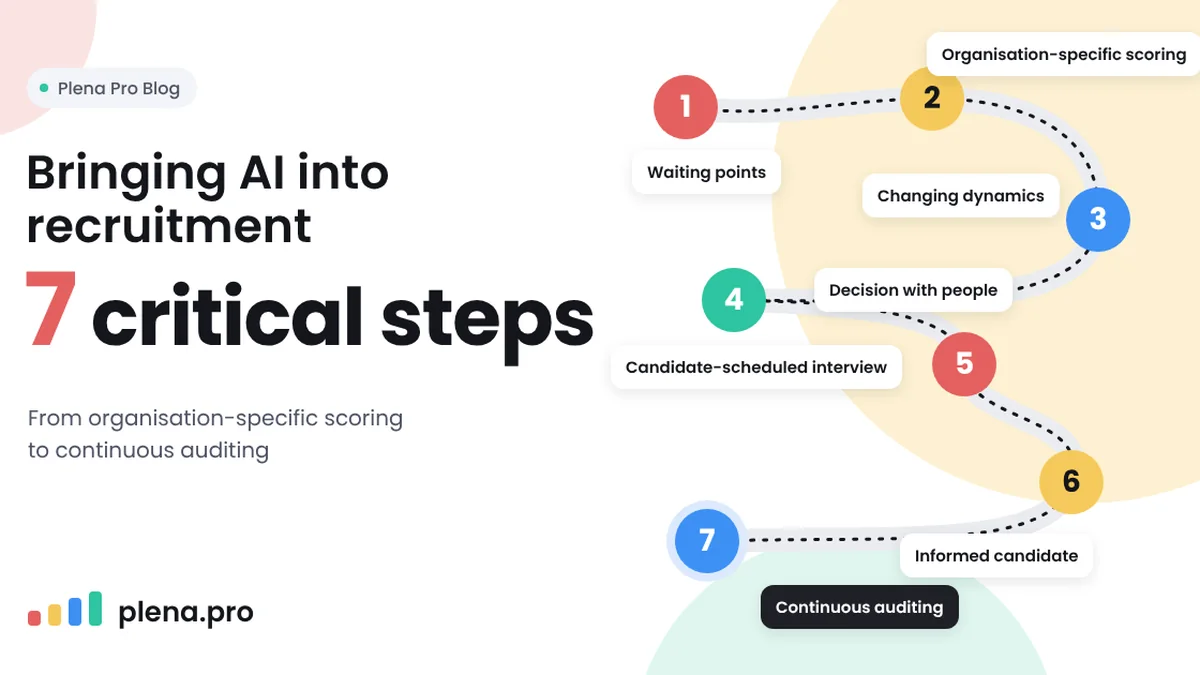
In this picture, the difference comes less from which tool is chosen, or whether the system was built in-house or bought in, than from how the system is set up, who makes the decision and how the outcomes are monitored. The seven steps below describe what needs to be put in place, and in what order, when bringing AI into your recruitment process.
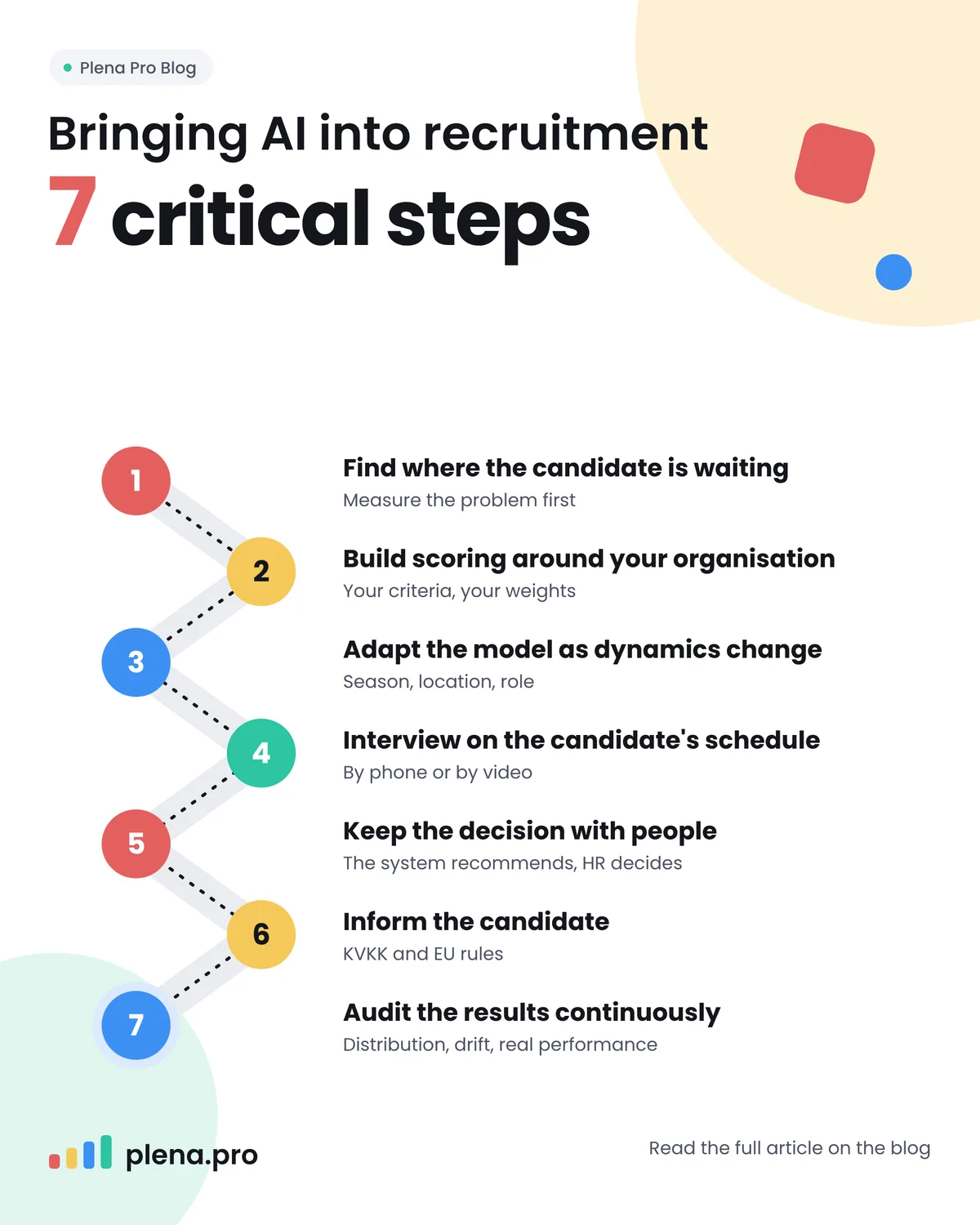
1. First, find where the candidate is waiting
Start with the problem, not the technology. Map your recruitment process end to end, from the position request to the candidate's first day, and measure the time spent at each step. How many days does it take to build a shortlist? How many phone calls does it take to schedule an interview? How many approval stages does an offer wait in?
In most organisations, what stretches the timeline is not the evaluation itself but the waiting between steps. Repetitive work such as drafting job ads, posting across multiple channels and screening CVs can be automated quickly. Taking this measurement before choosing a tool shows you where to position AI, and it becomes your baseline for measuring success later on.
2. Build the scoring model around your organisation
An off-the-shelf scoring model cannot anticipate your organisation's culture, your industry or the way the hiring department actually works. The evaluation criteria for a retail store associate and a software developer are different. Even for the same role, two organisations may differ in their priorities, culture and ways of working.
That is why the scoring model should be designed around the organisation. The competencies the role requires, the expected experience, cultural fit and the weight of each criterion should be defined jointly by HR and the hiring manager, and the HR team should be able to see at any time which criterion is being used with which weight. Information such as age, gender, marital status or photographs should not enter the model's evaluation; this is required both by the principle of equal treatment in Turkish labour law and by ethical hiring.
Then there is changing candidate behaviour. According to HireVue's 2026 report, 71 percent of candidates use AI when writing their CVs. As CVs grow more alike, keyword matching loses its power to discriminate. Basing the evaluation on role-specific questions and competencies, rather than on the words in a CV, produces sounder results.
3. Adapt the model as dynamics change
A scoring model is not something you set up once and leave alone. New store openings, seasonal hiring periods, a new location, a role whose content has changed, a tightening labour market or a new competency the organisation needs all change the definition of a good candidate. Ahead of peak season, for instance, the weight of shift flexibility may rise; for a remote team, written communication may become more decisive.
Even within a single organisation, one model may not be enough. Models that differ by brand, location or job family reflect each team's real needs more closely. What matters here is that changes are made in a controlled way. What was changed in the model, by whom, when and why should be recorded, and it should be possible to trace which model version each candidate was evaluated with. That record is the foundation of consistency, and of the auditing described in the final step.
4. Move the interview to the candidate's schedule
Scheduling the first interview is one of the most time-consuming steps in organisations that hire at volume. With an AI-assisted interview, the candidate can take part at a time that suits them, by phone or by video. A phone interview conducted through IVR also keeps the process accessible for candidates with limited access to a smartphone or the internet. In high-volume hiring, from retail and logistics to call centres and the service sector, this difference feeds directly into time to fill.
But an interview is an experience, and a poorly designed one loses the candidate. According to Greenhouse's May 2026 report, 63 percent of job seekers have encountered an AI interview, yet most did not have a good experience. Keep the questions short and specific to the role, explain to the candidate up front how the process will work, and name an HR contact they can reach when they have a question.
What the evaluation is based on matters too. Since February 2025, the EU AI Act has banned systems designed to infer people's emotions in the workplace and in recruitment. In a video interview, the evaluation should rest on the content of the candidate's answer, not on facial expressions or emotions inferred from tone of voice.
5. Keep the decision with people
AI's job is not to make the decision but to strengthen the decision-maker. Scores and shortlists are recommendations. The decision to advance a candidate or end the process should always remain with the HR team and the relevant manager.
Having a person in the decision, however, does not mean approving the system's recommendation with a single click. Accepting a recommendation without questioning it turns human approval into a formality. For real human oversight, the system should show why it put a candidate forward and on which criteria it found them strong or weak, and the HR professional should be able to accept or change the recommendation in light of that reasoning. The EU AI Act also requires that, for high-risk systems used in recruitment, this oversight is carried out by people with the competence and the authority to do so.
6. Inform the candidate
Candidates should know at which step of the process AI is used and for what purpose, who makes the final decision, and what route they can take to contest the outcome or request a human review. An informed candidate trusts the process more, expresses themselves better on the matters they are being assessed on, and finds even a negative outcome fairer.
In Türkiye, the framework for this is set by the KVKK, the Personal Data Protection Law. The privacy notice should explain the use of AI clearly, and situations that require explicit consent should be addressed separately. Article 11 of Law No. 6698 guarantees a person's right to object to an outcome against them that results exclusively from analysis by automated systems. How long the data of unsuccessful candidates will be kept, and when it will be anonymised or destroyed, should also be defined from the outset.
In the European Union, the rules are coming into force step by step. The EU AI Act covers not only companies operating in the EU but also cases where the system's output is used in the EU. It is therefore directly on the agenda for Turkish companies with EU subsidiaries or those working with candidates in the EU.
| Date | EU AI Act milestone relevant to recruitment |
|---|---|
| February 2025 | Emotion recognition systems banned in the workplace and in recruitment |
| 2 August 2026 | Transparency obligations began; a person interacting directly with AI, such as a candidate in an AI interview, must be told so |
| 2 December 2027 | Recruitment and candidate evaluation are classed as high risk; informing candidates about the use of AI, human oversight, monitoring of the system, record-keeping and the candidate's right to request an explanation of a decision concerning them come into effect |
The high-risk obligations were postponed from August 2026 to December 2027 by the Digital Omnibus regulation, which entered into force in July 2026. Postponement does not mean the obligation has gone away. This period is an opportunity to put candidate information, human oversight and record-keeping processes in place now.
7. Audit the results continuously
A model that works fairly on the day it is set up can drift over time. The candidate pool changes, new job channels come online, the model is updated. That is why scoring results must be audited regularly, and without fail after every change to the model. The main points to examine in an audit are these.
- Distribution across groups. Do shortlisting rates differ markedly across breakdowns such as location, age group or gender? This analysis should be carried out in aggregate, without exposing personal data, and in line with the KVKK.
- How often HR overrides the system's recommendation. If the HR team almost never changes the system's recommendation, recommendations may be getting approved without scrutiny. If it changes them very often, the model is not reflecting the organisation's needs.
- Whether scores match real performance. Are candidates who scored highly and were hired actually succeeding in their first months and staying with the organisation? If scores do not predict success, the weights need to be revisited.
- Candidate feedback and objections. The criteria that objections cluster around point to the model's weak spots.
- Records. It should be traceable which candidate was evaluated with which model version, against which criteria, and who made the decision. The EU AI Act also expects employers using high-risk systems to keep these records for at least six months.
Auditing is not a one-off project but a permanent part of the recruitment process. Considering that almost half of companies have no written policy on the subject, organisations that audit regularly both reduce their legal risk and earn the trust of candidates and employees.
How Plena Recruitment supports these steps
Plena Recruitment manages the process from job ad to onboarding in a single flow.
- AI-assisted job ad creation and multi-channel posting
- CV reading, scoring that is configured per organisation and updated as needs change, and shortlist recommendations
- A structure in which the decision stays with HR and every recommendation comes with its reasoning
- AI interviews by phone via IVR or by video, at a time of the candidate's choosing
- KVKK consent tracking, anonymisation and destruction of candidate data
- Reference collection via IVR, an end-to-end offer approval flow and, with Plena Archive, document collection, e-Government verification and automatic social security (SGK) registration
With this set-up, a job ad goes live in under five minutes, the shortlist comes down from five days to one or two, and onboarding preparation drops from three to five days to under fifteen minutes.
In short, AI can make recruitment faster and more consistent, and free up time for the HR team to engage with candidates properly. But it does not do this on its own. A scoring model built around the organisation and updated as needs change, a person who makes the decision, a candidate who knows what is being done and why, and an audit that monitors the results regularly. When these four elements come together, AI becomes a partner in recruitment that is both fast and trustworthy.
If you would like to see together how AI could be set up in your recruitment process, request a demo.
Frequently asked questions
At which steps of recruitment is AI used?
The most common uses are drafting job ads, reading CVs, scoring candidates and recommending shortlists, scheduling interviews and AI-assisted interviewing. In more advanced systems, reference collection, offer approval and onboarding paperwork are part of the same flow.
Can AI make the hiring decision?
It should not. AI presents a recommendation together with its reasoning; the HR team and the relevant manager make the decision. This matters for the candidate experience as well as for compliance with the KVKK and the EU AI Act.
How often should the scoring model be updated?
Rather than on a fixed schedule, it should be updated when needs change. A new location, seasonal hiring, a change in the content of a role or a drift uncovered in an audit are all triggers for an update. Every change should be versioned, and the results re-audited afterwards.
How are scoring results audited?
Shortlisting rates across groups, how often HR overrides the system's recommendation, the post-hire performance of high-scoring candidates and candidate objections are reviewed regularly. The analyses are carried out in aggregate and in line with the KVKK.
Does the EU AI Act affect companies in Türkiye?
It affects companies that operate in the EU or use the system's output for candidates in the EU. The ban on emotion recognition has applied since February 2025, the transparency obligations since 2 August 2026, and the high-risk obligations for recruitment apply from 2 December 2027.
Should candidates be told that AI is being used?
Yes. Candidates should know at which step AI is used and for what purpose, who makes the decision and how to object. This is a requirement of the KVKK's duty to inform and of the EU rules, and it is also the foundation of trust.
Sources
- LinkedIn data, January 2026 news report
- Aptitude Research and iCIMS data, 2026 industry report compilation
- Lighthouse Research Advisory, April 2026
- HireVue 2026 Global AI in Hiring Report
- Greenhouse press release, 1 May 2026
- Cuatrecasas, Digital Omnibus and employment, 13 July 2026
- Regulation (EU) 2024/1689, the EU AI Act; Articles 5, 26, 50 and 86
- Law No. 6698 on the Protection of Personal Data, Article 11