







 Plena Pro
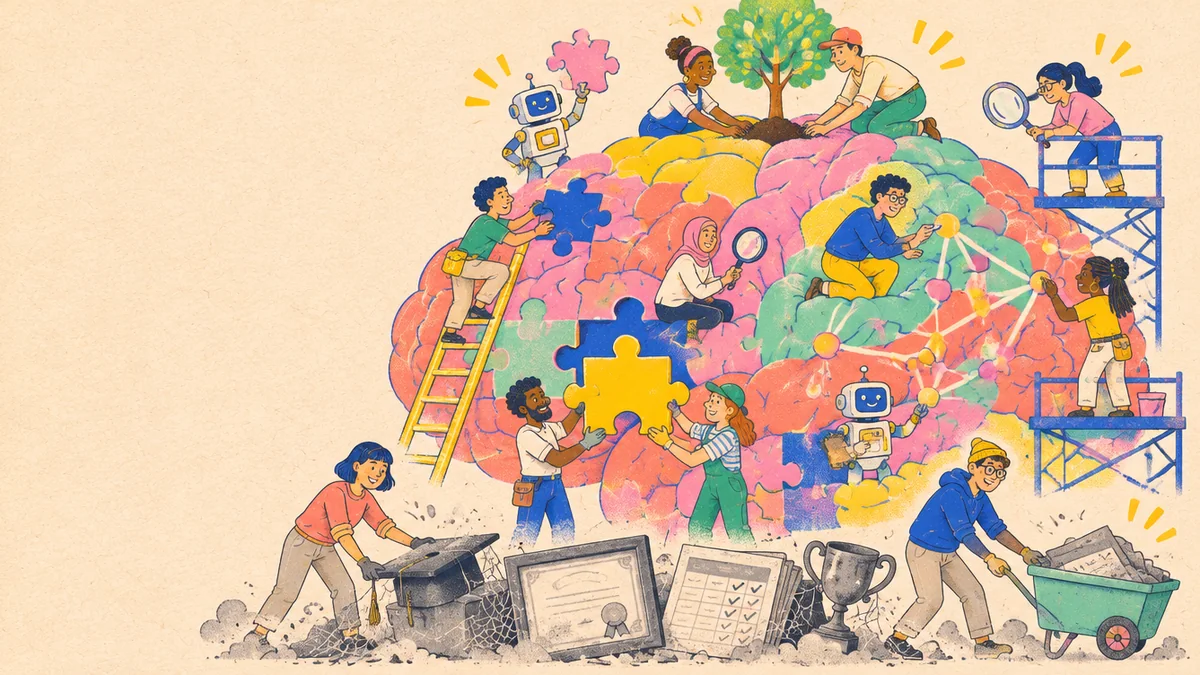
AI can now produce a report, an analysis or a presentation in minutes. That brings back a question the business world thought it had answered years ago: how do we recognise a good employee, and a good leader?
In this article we first look at what the familiar signals, such as a degree, a grade point average or a background in team sports, actually told us. Then, in the light of 2026 research, we examine why those signals are no longer enough on their own, which competencies are coming to the fore in employees and leaders, and how HR teams can make this shift visible.
What did the signals tell us?
A high grade point average was never just a number. It told the employer: this person works consistently, figures out the rules of the system and delivers on time. A background in team sports said this was someone who could recover from a defeat, knew their role and could run towards the same goal as others. A good university and a master's degree were proof that, in a world where knowledge was hard to reach, this person had acquired it.
In other words, all of these were proxies. Because we could not measure a person's competence directly, we judged it through these signals.
Today, access to knowledge is almost free. AI can produce a draft report, an analysis table or a piece of code in minutes. So the real question becomes: if anyone can produce the output, what sets a good employee and a good leader apart?
The degree keeps its value, but it is no longer enough on its own
The real problem is not the signals themselves but how competence is proven. Because AI can produce the output, a flawless piece of work no longer shows, by itself, who knows what.
The 2026 data shows this shift clearly:
- According to NACE's Job Outlook 2026, the share of employers screening candidates by grade point average fell from 73 percent in 2019 to 42 percent in 2026. Around 70 percent of employers say they hire on the basis of skills and expect candidates to describe those skills with concrete examples.
- In WGU's Workforce Decoded report, published in September 2026, 60 percent of 3,128 hiring professionals say AI has made it harder to assess candidates' real skills. The share who say they still have not worked out how to measure skills rose from 16 percent to 32 percent in a single year.
- In the same report, the share of employers who consider a degree important rose from 68 percent to 73 percent, and 91 percent find certificates valuable. The skills gap employers mention most often is critical thinking, followed by effective use of AI tools and verbal communication.
- In monday.com's survey of 1,701 managers, published in October 2026, 53 percent of leaders say it has become harder to assess an employee's original contribution, and 78 percent say they have changed how they evaluate their teams.
So the picture is more complex than saying a university education has lost its meaning. Employers no longer rely on a single signal; they try to read the degree, proven skills and real experience together. What has changed is that the era in which one document was enough to describe a person has come to an end.
For the employee: evaluating answers matters more than knowing them
A good employee used to be the one who knew the right answer. Today, reaching an answer is easy; what is valuable is being able to tell which one is correct and which one is useful. The competencies that stand out are evolving like this:
- Judgement and verification: Not accepting the text, table or analysis AI produces without questioning it. Being able to see which assumptions it was built on and where it might be wrong. It is no coincidence that critical thinking shows up as the biggest skills gap in the WGU data.
- Defining the problem correctly: The quality of the answer depends on the quality of the question. Someone who can state the real need, the constraints and the measure of success clearly gets far better results than a colleague using the same tool.
- Context and business knowledge: AI knows general knowledge, but it does not know your company's customers, its regulations, its past decisions or its internal dynamics. The person who brings that context into the work turns a generic output into one specific to the organisation.
- Combining different skills and learning fast: LinkedIn's Skills on the Rise 2026 report says those who stand out are not narrow specialists but people who can combine different skills: profiles who can work with AI, make sense of data, improve processes and collaborate across teams. Rather than investing in a single specialism, being able to keep adding new skills is a lasting advantage.
- Communication and persuasion: As producing an analysis gets easier, explaining it to the decision-maker, answering objections and bringing stakeholders together in a common direction becomes more decisive. The fact that verbal communication ranks among employers' top skills gaps confirms this.
- Ownership: Work produced with AI still has an owner. When something goes wrong, it is the person who delivered the work, not the tool, who is responsible. The employee who owns the result, checks it and can say stop when necessary becomes the most reliable team member.
The meaning of team sports is changing too. Team sports used to signal the ability to run towards the same goal with other people. In today's teams, digital assistants and AI agents sit alongside people. Being a team player now also means knowing what to delegate to whom, following up on the delegated work and owning the result together.
For the leader: building teams that work with people and AI agents
For the first time, managers are starting to work with non-human team members, and this is changing the definition of leadership. More than five in six of the leaders in the monday.com survey think good management now requires a different set of skills. 58 percent expect to be managing more AI agents than people within the next 12 months. And in KPMG's Global Tech Report 2026, based on 2,500 executives in 27 countries, 92 percent of executives say managing AI agents will be a critical skill within five years.
This picture brings five leadership competencies to the fore:
- Work design: Deciding which work stays with people and which goes to AI, and rebuilding the workflow accordingly. The leader no longer just assigns tasks; they design the system.
- Authority and control: Determining which data agents can access and at which step human approval is required. In the monday.com survey, 46 percent of leaders say they worry about losing control over agents' actions. This is not a technical matter but a governance one.
- Fairly evaluating invisible contribution: How much of a carefully prepared output is the employee's own thinking, and how much is AI's contribution? 47 percent of leaders say they spend more time than before reviewing and steering their team's output. Fair evaluation requires seeing the process and the judgement behind it, not just the result.
- Protecting learning: As routine work is automated, the rungs on which young people learn their profession disappear too. 34 percent of leaders worry that employees may lose important skills through over-reliance. The WGU data also shows that 54 percent of employers who struggle to verify skills have reduced entry-level hiring. Developing the experts of the future is a responsibility today's leaders must take on deliberately.
- Meaning and trust: As speed increases, so does uncertainty. The leader who can explain to people why they do this work, where they are heading and where they fit in this change protects the team's motivation and commitment.
In short, the leader is turning from the person who knows the most into the person who asks the best question, draws the boundaries and protects people's development.
Old signals and their new equivalents
The old signals are not disappearing; their meaning is changing. Once you look at what each one actually measured, finding its equivalent in the new era becomes easier.
High grade point average
It used to signal discipline, figuring out the rules of the system and delivering work consistently. Its equivalent today is being able to define an ambiguous problem and carry it through to a result. This is best shown by a case study based on a real situation, and by the interview.
A good university and a master's degree
They used to be proof of holding hard-to-reach knowledge. The equivalent today is learning fast and being able to keep adding new skills. This is shown by the skills, certificates and projects gained in the past year.
Team sports
They used to signal running towards the same goal, knowing one's role and recovering after a defeat. The equivalent today is collaborating in teams where people and AI tools work together, and owning the result. This is shown by cross-team projects and 360-degree feedback.
Seniority and years of service
They used to signal accumulated experience. The equivalent today is being able to transfer experience gained in different settings to a new situation. This is shown by role changes, career path and mentoring history.
Fast, flawless output
It used to signal knowledge and effort. The equivalent today is being able to verify the output and make the right decision. This is shown by the reasoning behind decisions, the errors caught and the visibility of the process.
Title and team size
They used to signal the scope of one's authority. The equivalent today is being able to design and manage workflows in which people and AI work together. This is shown by the processes built, the team's development and the people trained.
HR's new task: making competence visible
If competence is evolving, the systems that measure it have to evolve too. An HR infrastructure built on the CV, the degree and the annual appraisal form cannot see the skills that are valuable today. HR's new task is to track competence from within everyday work, continuously and fairly.
Plena Pro is an end-to-end HR platform built on this need. Our approach can be summed up in three steps:
- Looking for evidence in recruitment: In Plena Recruitment, AI-assisted interviews can be conducted by video or phone, and scoring can be configured per organisation. Each organisation defines what matters according to its own culture and the real needs of the role, instead of depending on a single signal such as a grade point average. We hold to an ethical principle here: in candidate scoring, AI should work according to the organisation's culture and transparent criteria.
- Tracking development in one place: In Plena İnsan, performance, career, training, leave and overtime live on the same platform. What an employee has learned, how they have contributed to which goal and where they have progressed in their career are seen as a single whole, not in scattered files.
- Mapping competence: Plena Growth, part of the Plena product family, maps competencies; it matches candidates, employees and positions with one another, suggests career paths and mentors, and links performance results to training inside the system and on external platforms. Plenalitik turns this data into analyses that leaders can act on.
The aim is for managers to see development and contribution continuously, rather than trying to guess how much of an output belongs to the employee. Leaders can then manage their teams of people and AI agents more fairly, and employees can see that their development is being recognised.
Conclusion: the signals have changed, people are still at the centre
A high grade point average, a good school or a team captaincy were never the goal in themselves. They were all proxies for the qualities we were really looking for: a person who can learn, take responsibility and create together with others. AI has weakened these signals, but it has not changed the qualities we are looking for; on the contrary, it has made them more valuable.
The employee of the new era is not the one who memorises answers but the one who can tell right from wrong. The leader of the new era is not the one who manages a team but the one who builds the system in which people and AI tools can work together, and who protects people's development within that system. And the ones who will manage this transformation are the HR teams that can evaluate competence not from the diploma but from the work put forward.
To talk about how we can support this transformation with Plena Pro, visit plena.pro or reach us at [email protected].
Sources
- NACE Job Outlook 2026 and spring update summary, University of Florida Career Connections Center
- WGU Workforce Decoded 2026 press release, September 2026
- monday.com AI Report 2026, October 2026
- KPMG Global Tech Report 2026 summary
- LinkedIn Skills on the Rise 2026 summary, afaqs